
Over the last several years, I have been trying to correct the inaccurate notion that the “average age of entry into prostitution is 13” wherever I see it, but it is becoming increasingly overwhelming. This figure is in newspapers, official reports from City of Portland, and many websites and pamphlets claiming to confront sex trafficking (but often conflate prostitution with trafficking, and take anti-prostitution stances that are actually harmful to women). When I contact them to correct the errors, they either don’t understand what I am explaining or just plain don’t care. I’ve also been accused of being a pimp, pervert, pedophile, and other unpopular beings, simply because I challenge the falsehoods.
Here is the latest example, found on The Oregonian on July 3, 2010. Columnist Eliabeth Hovde writes:
Boys and girls are being lured or forced into what they call “the life” at younger and younger ages. […] The U.S. Justice Department believes that the average age of entry into prostitution is 13 and that 100,000 children are used for commercial sex each year in this land of the free.
Department of Justice does state this figure in its website:
Although comprehensive research to document the number of children engaged in prostitution in the United States is lacking, it is estimated that about 293,000 American youth are currently at risk of becoming victims of commercial sexual exploitation. Richard J. Estes and Neil Alan Weiner, Commercial Sexual Exploitation of Children in the U.S, Canada and Mexico, University of Pennsylvania, Executive Summary at 11-12 (2001)
This led me to find the University of Pennsylvania study titled “The Commercial Sexual Exploitation of Children In the U. S., Canada and Mexico,” which in fact states:
The age range of entry into prostitution for the boys, including gay and transgender boys, was somewhat younger than that of the girls, i.e., 11-13 years vs. 12-14 years, respectively.
But as the title suggests, this study only surveys minors (“children”), which means it does not include anyone who entered into prostitution at age 18 or over, or those who entered as a minor but has since aged out. Imagine conducting a research on those who died as minors: the average age of death would be somewhere near 10-12, but it would be ridiculous to claim that the average life expectancy for the general population is 10-12. Similarly, the “average age of entry” among youth who were studied does not tell us anything about the actual average age of entry for everyone who is in or has been in prostitution.
That’s not all. For the sake of discussion, let’s pretend that in a small town, six minors enter into prostitution each year, one individual each for ages 12-17. That means that there is one 12 year old, one 13 year old, one 14 year old, and so on. The average age of entry in this hypothetical town is the average of these six individuals, which is (12+13+14+15+16+17)/6 = 14.5.
But when researchers arrive in this town, they don’t just survey these six minors: they will also survey others who have started prostitution in the years past. So for any given year when the research is conducted, there are one 12 year old (who entered at 12), two 13 year olds (entered at 12 and 13), three 14 year olds (entered at 12, 13, and 14), and so on. The average among all of these youth will be: (12+(12+13)+(12+13+14)+(12+13+14+15)+(12+13+14+15+16)+(12+13+14+15+16+17))/21 = 13.7–which is almost one year younger than the actual average age of entry.
This discrepancy is caused by limiting the research subject to minors. Those who entered into prostitution at age 12 has six years in which he or she might be surveyed (at ages 12, 13, 14, 15, 16, or 17), while those who entered at 17 has only one year, which artificially inflates the proportion of research participants who entered early. In short, we cannot know the actual “average age of entry” by simply averaging the age of entry reported by research participants.
Case in point. Below is a chart and table found in “The National Report on Domestic Minor Sex Trafficking,” produced by Shared Hope International, an anti-trafficking group.
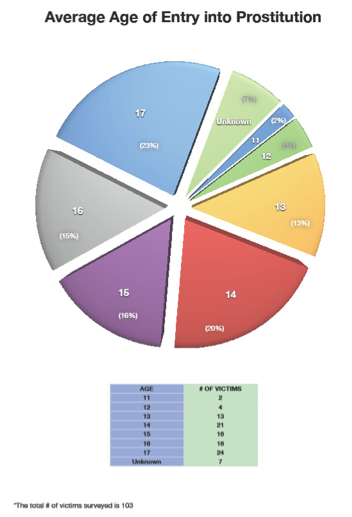
This chart is based on Shared Hope International’s 10-city study on minor sex trafficking. In the same page where this chart appears, Shared Hope founder Linda Smith states “The average age that a pimp recruits a girl into prostitution is 12 to 14 years old.” But interestingly, the chart does not support this statement: the average of all responses represented in the chart/table is 14.97, which is much higher than Smith’s “12 to 14” figure. Plus, simply averaging all the responses is not enough, for the reason I pointed out above. So when we adjust the numbers to compensate for the over-representation of those who entered early, the re-calculated “average of entry” turns out to be almost 16 (15.91).
This calculation is rudimentary and at best an approximation, since we don’t have access to the complete data or truly representative sample. But I suspect that it is much closer to reality than 13, which is what journalists, politicians, and many anti-trafficking activists claim.
There is also an element of common sense here. Assuming normal distribution (bell curve), the average of 13 implies that for every 20 year olds entering prostitution, there are equal number of 6 year olds doing the same. That, common sense should say, cannot possibly be true. The alternative is that the distribution isn’t normally distributed, but heavily clustered around 10-12 year olds to balance everyone who enters into prostitution 16 or older. This again is implausible, as we simply do not find that many 10-12 year olds in prostitution, at least in the United States. The only logical conclusion is that the average age is not anywhere near 13, but is much closer to 18.
That doesn’t diminish the fact that some very young children are victimized, and we should do something about it. But it is not trivial if the average age of entry is 13 or 16 or even 18, because it drastically changes what social policies we must enact to combat forced prostitution and trafficking. I feel that many journalists, politicians, and anti-trafficking activists use the lower figure merely for the shock value, to arouse strong emotional reaction toward the issue, but they are acting irresponsibly when they distort reality. We need to understand reality as they are and craft rational and sensible responses to the problem, rather than indulging ourselves in panicked frenzy.
(note: changed the title to make it straightforward)
The first 3 reports are all referencing the same report, and they are what almost every anti-trafficking organization uses it also. It is an extremely in-depth 2 year study that told us 10 years ago that trafficking of minors is a pandemic. There has been little to no response, which is why children are disappearing without a trace. Currently, pimps are networking on ways to ensure victims are disposed of so that the remains will not be identifiable. There are women and girls on wait lists for services, calling every month waiting and hoping that they can leave there pimp, but they are unable to unless they have housing. It is irresponsible to imply that there is any sort of “panicked frenzy” or making up of statistics.
The Portland Vice officers see an average of 3-5 trafficked minors a week. Currently,there is no data tracking – and there is none that I know of in any city unless there are funds available to do so.
Last November, during a routing traffic stop in Beaverton a 14-year old being prostituted by her family was rescued. http://www.oregonlive.com/portland/index.ssf/2010/05/portland_man_pleads_guilty_to_1.html
Just last week 3 more teens were rescued: Portland Police rescue teen girls from sex trafficking http://www.kgw.com/news/local/Portland-Police-Rescue-Three-Teenage-Girls-in-Sex-Trafficking-Ring-97988664.html
Eugene: Teenage prostitutes in Eugene: ‘Our main goal … is to rescue these girls’
http://www.katu.com/news/local/69478772.html
NYTIMES: Recession Drives Surge in Youth Runaways http://www.nytimes.com/2009/10/26/us/26runaway.html?_r=1
If you don’t like the way SHI calculated the #’s I’ll be happy to locate a report from Chicago, New York, Minnesota or California that has basically there same information. The girls are getting younger and younger, because there is a DEMAND. Last month on International Blvd in Oakland a 9-year-old was being prostituted. Information provided by http://www.misssey.org/.
Comment by Carol Fenton — July 13, 2010 @ 7:35 pm
Hi Carol,
Thanks for your comment. I took up the UPenn study because, as you say, it is the study everybody (mis-)uses, but I am interested in reading other reports. Please do send them to me at emi AT eminism DOT org.
I do know of one other study that was also funded by Department of Justice: “The Commercial Sexual Exploitation of Children in New York City” from the Center for Court Innovation, which uses a better sampling technique to get a more accurate picture. It found:
Many of the professionals who offered guidance to the John Jay research team believed that the average age of entry for girls was much younger than for boys, but boys and girls differed only slightly in our sample. The average age of entry for females was 15.15 years and males 15.28 years, but a higher percentage of boys (19%) entered the market under the age of 13 than girls (15%). And transgender youth tended to start out later in their teens (16.16 years) than boys or girls. Where boys, girls and transgendered youth differed the most was not in their age of entry, but in how they entered the market.
This study isn’t perfect, but it does contradict many people’s claim that the average age of entry (for minors) is 12-14. But as I said, I’d love to look at other studies if you have any.
Comment by emigrl — July 13, 2010 @ 8:45 pm
Wow, my brain can’t follow all those numbers, but I totally believe you. Thank you for dispelling the myths!
Comment by amie — July 13, 2010 @ 10:28 pm
Point 1: I don’t care what age children are entering-no child should be forced into prostitution at any age.
Point 2: I like good science.
The problem with most studies on trafficking is that they tend to be full of holes… I applaud those trying to create some stats, but the reality is: they can usually be picked apart.
We will never get clear numbers about who is and is not being exploited, what the true average age of entry is for sex workers, as well as other important information, as long as sex work is forced into the shadows. Many sex workers are never accounted for in these studies because they are not the one’s showing up in raids, at shelters, in hospitals…they are quietly staying below the radar, doing their job, minding their own business trying to make a living or simply get by in life until something better comes along. Many of us that choose the lifestyle as a career and love it certainly don’t want unwanted attention, so we are often forced to live double lives and keep our stories private.
We need people asking questions and talking about these things… There are some *really* young victims out there… We need better child welfare systems. We need more specialized foster families. We need more long term rehab beds for these kids. We need better laws. We need to decrim to separate the true victims from those that are NOT being trafficked…so that resources are not wasted, victims can come forward more easily, and reporting from other sources (workers and clients) can come in more easily. We while we need better science with some of these studies, we still need people out there trying to get to the bottom of this…trying to get at the truth. Eventually it will come, by both the imperfect efforts of some of the research, and critics calling stats into question. Having two smart women such as the above participating is what will move us all forward as a movement to save the children being harmed…no matter what age, no matter when they started.
Godspeed
Comment by Megan Morgenson — July 13, 2010 @ 10:40 pm
Thanks. I’ve wondered about this statistic. I know the average age is probably getting younger; I myself entered at about age 16 or 17, I can’t recall exactly. However, I don’t think bandying about statistics that aren’t well proven do anyone any service. The truth is horrific enough. I’ll follow to see if anything else surfaces.
Comment by Ex Working Girl — July 16, 2010 @ 12:02 am
Carol, if Oregon is so gung ho (no pun intended) to eradicate the exploitation of young people, why this slap on the wrist?
http://becauseshematters.blogspot.com/2009/06/business-owner-receives-slap-on-wrist.html
Comment by Ex Working Girl — July 16, 2010 @ 12:05 am
[…] City Commissioner Dan Saltzman, Multnomah County Commissioners Diane McKeel, and others invoked the nonsensical and debunked claim that “the average age of entry into prostitution is 13,” as if they are utterly ignorant about […]
Pingback by Eminism.org » City and County commissioners continue to broadcast smooth lies that comfort citizens — July 23, 2010 @ 7:39 am
Your analysis of the distortions inherent in the way these averages are calculated is nothing short of stunning. I know of no one who has made a more compelling case for the abandonment of that highly abused 12-14 statistic. I have recently been caught up in the subject on my own blog and have attracted the wrath of a number of rescue industry supporters.
I am an engineer with some training in probability theory, but what you discovered never occurred to me before I found this post.
-Dave
Comment by Dave — September 25, 2010 @ 11:50 am
Thank you so much for this analysis! Today I published a column in which I attempt to arrive at a reasonable estimate of the average age of entry into prostitution in the United States, using a recent survey of escorts as a basis and your estimate for the average age of underage streetwalkers. I’ve of course linked this post, and here’s mine if you’re interested (second question down): http://maggiemcneill.wordpress.com/2010/11/27/november-q-a/
Comment by Maggie McNeill — November 27, 2010 @ 11:38 am
[…] for underage girls? Well, guess what; it still isn’t 13 even for them. As explained in this analysis, it’s about 16. If we average the two figures (26 for adult streetwalkers and 16 for underage) […]
Pingback by Average Age of Entry « Bound, Not Gagged — December 4, 2010 @ 10:53 pm
It is amazing to me that people are on here debating whether the average age of young women being forcibly trafficked is 13, 14 , or 15. It’s like debating whether someone was killed with butter knife a steak knife or a sword. Who cares! Isn’t the problem that it IS happening and it needs to stop?
Comment by WTH — January 11, 2011 @ 2:03 pm
WTH,
What is amazing is that you don’t see the importance of understanding reality as it is in order to craft an appropriate response. For example, if you assume that bunch of 10-year olds are being kidnapped into sex trafficking (which one must believe if the average age is somewhere near 13), your solution might be to intensify surveillance at schools and around communities. But that would be a complete misdirection of scarce public resources if majority of the “children” are 16 year old and up, who are running away from home.
Without good understanding of the nature of the problem, you can’t enact rational and sensible responses that actually work. If you don’t care about that, then please shut up and never speak about the issue again because your irrational and irresponsible “who cares?” attitude is making things worse.
Comment by emigrl — January 11, 2011 @ 4:47 pm
Emigirl — first post here, attracted by the deficiency in good realistic stats. Did Carol — the first poster above — ever give you the studies she had mentioned, which presumably show better treated, non-miscalculated results for age of entry? I am really curious about that.
The fact that the report you discuss here did not correct for the cumulative bias you indicated is nothing short of amazing. In case you are involved with such studies — do you happen to know why such mistakes are made? The use of statistics in the social sciences already has some history; good courses on statistics are offered in all major university courses for social scientists. How come studies on such an important topic — and studies that end up being the basic source of information for interested activists — still contain this kind of problem? There are people with a good command of statistics and data gathering design somewhere working on this topic — aren’t there?
Comment by Asehpe — January 16, 2011 @ 10:47 pm
By the way, I just found this report that claims 1/3 of prostitutes in the Ukraine are under 18 years old. What do you think of this claim, judging by what you know on the topic; and how about its source (www.ecpat.net)?
Comment by Asehpe — January 16, 2011 @ 11:10 pm
I’m very pleased that Sgt. Geiger has stated that the Portland Vice Officers are not tracking what they and the FBI had previously stating they have been seeing – as if it were being tracked.
There is a huge need for better statistics, and there is no funding to do this.
As Emi stated there are ramifications to the response when poor information is provided, although there are no services in Portland or the state of Oregon for trafficked youth until the city of Portland provided funding for 4 beds at the Janus Youth Garfield House, 2 additional headcount at the Sexual Assault Resource Center, and 2 additional Vice officers.
What are your thoughts on this response Emi?
Comment by Carol Fenton — January 16, 2011 @ 11:14 pm
I’m surprised that there is no funding for more statistics, Carol. What is the rationale behind that? The topic isn’t important enough? There are too many other equally important things to do? Not sufficiently many interested researchers?
Comment by Asehpe — January 17, 2011 @ 2:36 pm
hello emi, just to let you know i passed this article on to a list and some mainstream journalist thinking about the age-13 thing. i would like to know what other sources there are besides the upenn study, too.
ashton kutcher made a big show of age 13 at the nutty luxor debate i attended, which i hope you saw. i don’t have your email or would send the link to you.
best, laura
hrrp://www.lauraagustin.com
Comment by laura agustin — February 13, 2011 @ 7:03 am
Hello Emi, As (I suppose) a mainstream journalist, I’d also be very interested in any other sources that trace some of these oft-bandied-about trafficking stats. I was also wondering if an unedited version of that nutty Luxor debate exists anywhere. Best, Andrew
Comment by Andrew Marshall — February 23, 2011 @ 9:41 pm
There is one glaring problem I see in this post, and in the chart from “The National Report on Domestic Minor Sex Trafficking”. My understanding of the statistic of the age of minors being trafficked is 13 is about actually documaneting that the minors (mostly female) who are rescued from these situations were on average trafficked when they were 13. I am getting this info from the movie “Very Young Girls” done by GEMS http://www.gems-girls.org/. They are working directly with theese girls and women, and I would imagine that their statistics are directly from what they are seeing in the girls they are working with.
The chart above is titled “Age of entry into prostitution”. I am assuming, though I should really go read and find out for myself, that they are getting these statistics for their chart from a cross section of prostitutes, not just trafficked ones. In that case, you are going to get a whole different spectrum of ages. If the documented cases of women and girls (and boys in some cases) who have been trafficked, ie forced into the profession of sex work by coercion, can say that the average age is 13, based on hard evidence, then what is there to dispute?
Now, it seems other agencies are misusing this statistic for their own purposes. That is where it all goes awry.
Comment by Lilithe — February 24, 2011 @ 1:05 am
Lilithe,
I don’t think that it is the case that GEMS’ use of “average age” come directly from their program. Here’s the “facts” found on GEMS site, and where the statistics (supposedly) come from:
The USDOJ is the same page that I mention in my post, referring to the same UPenn study (Estes & Weiner). So when GEMS state that the average age of entry is around 13, they are using the same distorted figure that I’m criticizing.
Here’s another “fact” on GEMS site:
This figure is highly problematic because the number is simply the sum of the number of minors who fit into all groups that are considered “at risk” for engaging in prostitution (either on their own or by force or deception). Such group include: “runaway youth,” “female gang members,” “members of sexual minority groups,” “users of psychotropic drugs,” etc.
Plus, these groups are not mutually exclusive, so those who belong to more than one of these (and there are more that I didn’t mention). For example, a lesbian runaway youth who uses drugs and joins a gang is just one person, but she is counted four times, artificially inflating the population of “at risk” youth.
Okay, one more “fact” from GEMS:
National Runaway Switchboard does estimate that 1.6 million children run away from home each year; most return within a day. But the Switchboard does not have any estimate about how many of them are approached by a trafficker or solicitor: that part is simply not in the report that is often cited as the source for this information.
I did track down this mysterious factoid, but to the best of my knowledge there is no concrete source to back up this information. The more popular version usually claim that a third of runaway youth are approached within 48 hours (rather than estimating “the average,” which is impossible to calculate since not every runaway youth is approached–most go home quickly, remember?).
It appears, based on my research, that this “statistics” originated from a presentation given by a small homeless youth advocacy organization in the Midwest, but it is unclear if it is the actual data from its participants, or simply an opinion someone had. Regardless, until someone shows an actual source for this info, we should remain suspicious.
So, in conclusion: there is no “hard evidence” anywhere. GEMS is irresponsibly propagating “facts” that it cannot show any evidence for.
Comment by emigrl — February 24, 2011 @ 2:13 am
[…] groups repeatedly claim that the average age of entry into prostitution is 13. I’ve debunked this myth before by pointing out problems with how the number has been reached, but here’s a more […]
Pingback by Eminism.org » Simple chart debunking the “average age” myth — April 21, 2011 @ 11:17 am
[…] July, I debunked the false claim that “the average age of entry into prostitution” is somewhere around 13, which has […]
Pingback by Eminism.org » Another myth debunked: why “a third of runaway youth are trafficked within first 48 hours” is NOT true — April 24, 2011 @ 1:37 am
[…] Common Myths 1.0: Why “facts” presented by the anti-trafficking movement are wrong 1.1: Myth #1: Average age of entry into prostitution is thirteen 1.2: Myth #2: 300,000 children are at risk of being sexually exploited 1.3: Myth #3: 1/3 of 1.6 […]
Pingback by Eminism.org » War on Terror & War on Trafficking – A New Zine Released! — May 22, 2011 @ 10:12 am
[…] entry of underage prostitutes, not all prostitutes, and their published figures don’t back it up; the actual figure is 16. As I explained in a December essay, the true average for all prostitutes is about […]
Pingback by Lies, Damned Lies and Statistics | Nobody's Business — July 10, 2011 @ 10:16 pm
[…] enter ‘the life’ between the ages of 12 and 14,” which is based on a demonstrably faulty interpretation of data. T.O.M.’s story is sad and infuriating, but its use as “a case in point” is […]
Pingback by Eminism.org » Some thougts on the Newsweek story on the new Farley “research” — July 19, 2011 @ 3:25 am
[…] [6] http://eminism.org/blog/entry/62 […]
Pingback by Where is the evidence? | Thierry Schaffauser — September 4, 2011 @ 2:33 pm
[…] they mean the 18-20 range. The same report included statistics which showed that the average underage prostitute enters the trade at 16, then in their text erroneously state the average as 12-14, absurdly contradicting their own […]
Pingback by October Updates (Part Three) « The Honest Courtesan — October 4, 2011 @ 8:18 am
[…] what I had expected from seeing the trailer which repeated the myth of extremely low the “Average Age of Entry” into prostitution. It also quoted people claiming that there are 100,000 to 300,000 […]
Pingback by Eminism.org » Film “Sex+Money”: Evidence #7290 that the Mainstream Anti-Trafficking Movement is a Conservative Christian Movement — October 8, 2011 @ 10:25 am
[…] Weiner’s data we can’t be sure exactly what statistical errors they made, but as Emi Koyama of Eminism explains, there’s a built-in error caused by using the artificial cutoff age of 18: For the sake […]
Pingback by The Law of Averages « The Honest Courtesan — November 27, 2011 @ 7:35 am
Thank you. I had always assumed that the “average age is 13” statistic was based on worldwide data, not just data in the US (which is why the data didn’t send up red flags to me since in Asia younger children are more valuable to brothels because they can be sold as “virgins,” so many children age 6 to nine are forced into prostitution (the youngest case I’ve read about is age 3).
Comment by Gale — January 24, 2012 @ 8:55 am
Thank you for tackling this.
Comment by Nancy — March 25, 2012 @ 10:04 pm
[…] information, they have little to no hope of being effective. For example, if we believe that the average age of entry to prostitution is 13, we will enact strategies and social policies that target 13 year olds, and will not address the […]
Pingback by Some Problems I Have with Melissa Farley | Sex Work Activism in Los Angeles — January 16, 2013 @ 6:13 pm
[…] Unpacking the myth: “the average age of entry into prostitution is 13″ – Emi Koyama […]
Pingback by Critiques of Melissa Farley | Sex Work Activism in Los Angeles — January 16, 2013 @ 6:15 pm
[…] now arrested into “state protection” rather than the court system, to anti-sex work feminists shrieking fallaciously that the average age of entry into prostitution is 13, to the sex workers’ rights movement trying to figure out a way to help homeless queer and […]
Pingback by A Nation of Sex Workers: An Interview with Tracy Quan — March 5, 2013 @ 7:13 am
[…] efforts result in the internment and police abuse of Cambodian sex workers. Magnanti references Emi Koyama, Maggie Mcneill, and Laura Agustin as she debunks the histrionic sex work abolitionist statistics […]
Pingback by Week In Links–March 22 — March 22, 2013 @ 2:37 pm
[…] The Average age of entry into prostitution is NOT 13 […]
Pingback by Let’s Talk About Sex…. Work Resources | plasticdollheads — February 17, 2014 @ 11:32 am
[…] Jenna Novak from the Polaris Project (an anti-trafficking, anti-prostitution lobbying group), had come from the lower 48 to do most of the presenting. She mostly offered the typicalinformation. […]
Pingback by CUSP Goes to the Trafficking Conference – Sex Trafficking in Alaska — July 15, 2014 @ 9:38 am
[…] of what’s wrong with these numbers, I recommend reading Emi Koyama’s blog post, “The Average Age of Entry Into Prostitution is NOT 13.” It’s one of the first pieces that I looked at as a reference for my Atlantic […]
Pingback by Fake Sex Work Statistics at The Advocate — September 15, 2014 @ 1:13 pm
[…] bold move even within the typically-dubious realm of sex-trafficking statistics (the idea that the average victim is first-trafficked at 12-years-old is also suspect). None of these stats are […]
Pingback by Senators Feinstein, Portman Want to Expand Wiretapping Authority to Combat Sex Trafficking - Hit & Run : Reason.com — November 19, 2014 @ 2:16 pm
[…] move even within the typically-dubious realm of sex-trafficking statistics (the idea that the average victim is first-trafficked at 12-years-old is also suspect). None of these stats are […]
Pingback by Senators Feinstein, Portman Want to Expand Wiretapping Authority to Combat Sex Trafficking | Michigan Standard — November 19, 2014 @ 11:01 pm
[…] my beloved NPR fell for the story ~ including tossing in a quote containing the oft used bullshit about the average age of entry into prostitution is 13. It is a lie, people! But just like the […]
Pingback by The Sex Trafficking White Slave Trade Stories Never End (Or, The Same Approach After All These Years) | Cult of Gracie — March 8, 2015 @ 7:48 am
I’m not sure it is a “lie”, but it is certainly untrue. “Lie” implies intention to deceive. That may or may not be the case among the multitude of voices that parrot this trope. I am very familiar w/ the widely and properly criticized Estes/Weiner study. In their defense, the Estes report itself contains many caveats as to the limitations of their findings, e.g. “Technically speaking, the project was not able to deliver rigorously (representatively) drawn samples for analysis of each study focus.” (pg 22 of the full report), and on page 10 of the Executive Summary a full page titled “A Cautionary Note”:
https://maggiemcneill.files.wordpress.com/2011/04/estes-weiner-2001.pdf
Thank you for your rigorous yet easy to follow explanation about how some of these numbers are rigged by the methodology.
Peace, Justice and Freedom…
avra
Comment by avra cohen — March 29, 2015 @ 9:08 pm
The writer of this piece sounds completely uninformed and colonial. Anyone working in the field–and clearly you have not–will say that age is very difficult to gage. Most poor people around the planet do not even know their own birthdays. Add to this that the trafficking of children is pushed very much underground and to actually find every underage prostitute is impossible, as it is to find all the women trafficked. But this is a good estimate based on UN reports as well as other agencies. This was never meant to be a national average for the US but an indicator of an international average. What is shocking is that this writer assumes that people discussing these abuses are looking for shock value (again, this person has clearly have not worked in the field and it sounds like s/he remains in a very privileged socioeconomic space within a very privileged nation). The reality is that prostitution is happening with extremely young children around the world. This writer needs to get a passport!
http://www.thestar.com/news/world/2013/10/13/meet_the_girls_who_are_born_to_be_prostitutes.bb.html
Comment by disfasia — August 15, 2015 @ 3:40 pm
@ disfasia
The FBI claims that the figure is the average in the United States, and this blog post debunks that. Neither FBI nor I are discussing the international average.
Comment by emigrl — August 15, 2015 @ 4:56 pm
Great. Maybe some day, when your blood-soaked head hits the floor after being beaten severely by a man whose ultimate turn-on is buying women, you’ll think of just how liberated your were that you were able to freely pursue the sex trade as a career, and just how empowering that was.
In theory, the old “no one holds a gun to your head” line sounds reasonable…but that is seldom the reality.
Or….maybe when that 16 year old girl gets beaten beyond recognition by a group of pimps in a public bathroom in a city park, and soon thereafter dies from drug addiction, you can feel proud for exposing the distortions spread by the DOJ about prostitution stats, so that she felt that a career as a prostitute was OK for her.
( My cousin, BTW)
All I am saying that in a world of great causes, especially those for women, you get to pick your cause….and the pro-sex trade cause is a really sucky choice.
The point here is that the average age of entry involves CHILDREN. And that is an indisputable FACT.
And that is appalling to most, and it is the TRUTH.
Comment by josephec — May 30, 2016 @ 7:13 pm
[…] already has the strong bullshitting skills necessary to flourish in anti-trafficking, a realm where facts don’t seem to matter and scare-tactics do most of the talking. Due to the massive amounts […]
Pingback by Top Six Reasons Melania Trump Should Get Involved In Anti-Trafficking Campaigning — Tits and Sass — March 2, 2017 @ 8:02 am
If the percentage of underage prostitutes is .01 percent, that is far too high. Your post fails to note that there was a thirteen-year-old in every example. That’s unacceptable, as are all of the surveys of children under seventeen. While even 21 is young, as a life choice, it’s at least legal. Eighteen or younger is really too young.
Comment by Victor — November 10, 2023 @ 11:35 am